How Humidity in Southeast Asia Affects Wood Furniture — and What It Means for Your Nightstand
Last month I visited a three-room HDB flat in Bedok with a client who had just moved in. Her brand-new solid wood nightstand — a walnut piece with French light luxury curves — had begun to show a faint haze on the surface and the drawer was sticking slightly. The air conditioner had been running only at night. During the day, the relative humidity inside the flat had crept up to around 78%. Within four weeks, the joinery told the story. It is a story I have seen repeat itself across Tampines, Punggol, and Toa Payoh, and it is the reason this guide exists.
Why Singapore's Climate Is Hard on a Solid Wood Nightstand
Singapore sits almost on the equator. Outdoor relative humidity runs between 65% and 90% for most of the year, and indoor humidity in a typical HDB flat without dehumidification swings between 55% and 80%. Solid wood is hygroscopic — it absorbs and releases moisture as the surrounding air changes. A nightstand made from ash, oak, or walnut will gain or lose roughly 1% to 3% of its moisture content over a 24-hour cycle during a wet spell. That sounds small, but on a panel 38 cm wide and 30 cm deep, it translates into expansion or shrinkage of 0.4 mm to 1.2 mm — enough to make a drawer rub, gap at a corner, or develop a hairline crack along the grain.
Glue joints are usually the first casualty. A standard PVA bond loses about 15% of its strength when wood moisture content climbs from 10% to 18%, which is the range a Tampines condo can hit on a stormy afternoon. After that, you see movement: the nightstand door warps by 2-4 mm, the back panel pushes outward, or the legs develop a slight lean because one corner of the room sits closer to a balcony door. None of this is a manufacturing defect. It is wood doing what wood does.
How Does Humidity Damage Specifically Affect a Nightstand?
Because a nightstand is small, it reacts faster than a 2 m dining table or a 220 cm wardrobe. The surface area to mass ratio is high, so moisture moves in and out within hours rather than weeks. Here is what I look for when inspecting a piece that has been through a humid stretch:
- Drawer faces: a 0.5-1 mm lip shows where the solid wood panel has swollen and pushed past the carcass.
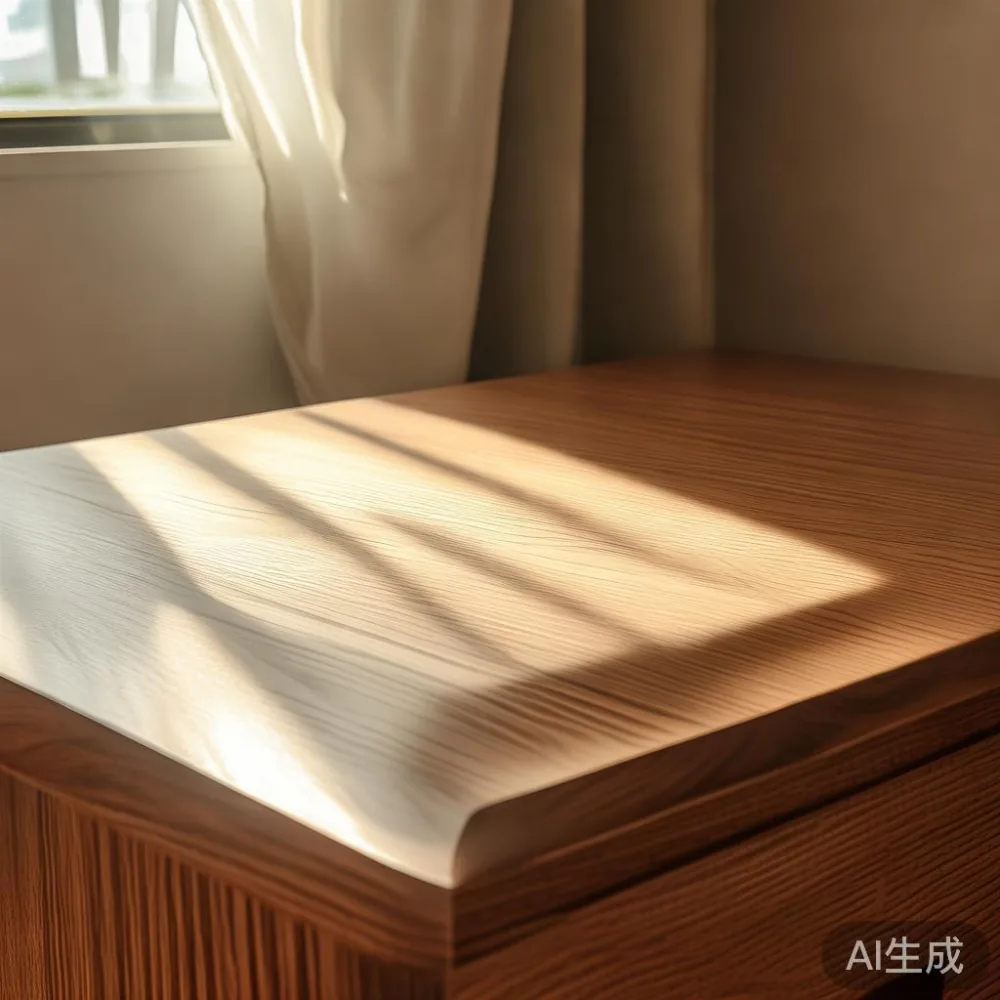
- Top surface haze: a dull, whitish film caused by moisture trapped under a wax or lacquer finish.
- Hairline splits: usually 1-3 cm long, running along the grain on end-grain surfaces like the back of a leg.
- Sticking drawers: the drawer bottom absorbs moisture and swells against the sides, adding 1-2 mm of friction.
- Musty smell: a sign that interior moisture is above 14% and the piece needs attention.
None of these are irreversible. With a dehumidifier, a light sanding, and a fresh coat of hard wax oil, most pieces come back to original condition. The point is to catch them early.
What Humidity Range Should You Keep Your Bedroom At for Solid Wood?
For any solid wood piece — whether it is a nightstand, a bed frame, a dining table, or a wardrobe — the target indoor relative humidity is 45% to 60%, with a room temperature of 22-26 °C. This corresponds to a wood moisture content of roughly 8% to 12%, which is the range furniture makers kiln-dry to before assembly. Stay inside this band and your nightstand will hold its shape for decades.
In Singapore, the cheapest way to stay in that band is a small desiccant dehumidifier rated at 6-8 L/day for a 12-15 m² bedroom. Running it on a hygrostat set to 55% RH costs about SGD 18-25 per month in electricity. If you already own a Daikin or Mitsubishi inverter unit with a dry mode, use it for 2-3 hours in the late morning when outdoor humidity peaks. Avoid placing the nightstand directly against an exterior wall — I always pull mine at least 8-10 cm away so air can circulate behind it.
Is American Light Luxury Furniture Better Suited to Singapore Humidity Than European Pieces?
Not necessarily — design language and construction method matter more than style label. American light luxury tends to use thicker panels (22-25 mm) with looser tolerances, which gives the wood room to move. European light luxury often features tighter joinery, thinner veneers, and sleeker profiles that show movement sooner. Post-modern light luxury, with its mix of materials, sometimes pairs a solid wood nightstand top with a marble table base or a brushed brass pull — both of which respond differently to humidity, so the weak point becomes the joint between them, not the wood itself.
What actually protects a nightstand in a Punggol HDB is the kiln-drying specification. Ask for wood dried to 8-10% moisture content, then acclimatized in a Singapore warehouse for at least 14 days before delivery. A reputable Foshan maker such as MIDHILL kiln-dries to that range and re-checks moisture content before packing. That single step removes most of the risk. After all, wood that leaves the factory already at Singapore-equilibrium moisture will move far less once it sits in your flat.
How Do I Style a European Bed Frame in a Small Apartment?
Pair a European bed frame in a small apartment by anchoring it to one wall, choosing a low-profile solid wood nightstand within 2 cm of the frame's height, and limiting the rest of the bedroom palette to two materials so the frame's detailing reads clearly.
In practice, that looks like this in a typical 10-12 m² HDB bedroom. Place the bed frame against the wall opposite the wardrobe door — never under a window where afternoon sun drives heat into the headboard. Pick a nightstand between 45 cm and 55 cm tall, the same wood species as the bed frame if possible (oak with oak, walnut with walnut), and push it flush to the mattress edge. Skip the second nightstand if the corridor to the door is narrower than 70 cm — you need at least 60 cm of clear walking space, which is also what most HDB lift landings offer at 1.1 m wide.
For the rest of the room, one accent chair in a neutral fabric, one pendant light at 1.6 m above the floor, and a single piece of wall art above the headboard is enough. If you want to add a chest of drawers, an L-shape chest of drawers for dining room storage is a clever way to take pressure off the bedroom wardrobe, but make sure it sits in a room with a dehumidifier running — a dining room that opens to the balcony can hit 75% RH by lunchtime. Keep the bed frame styling tight, and the small apartment feels 30% larger than its actual floor area.
Practical Checklist Before Your Nightstand Is Carried Up to Your Floor
Singapore HDB corridors are typically 1.2-1.5 m wide and lifts are about 1.0 m deep by 1.4 m wide with a 90 cm door. A flat-pack nightstand under 60 cm in any dimension will clear them easily. A fully assembled piece over 65 cm wide should be checked against your lift. MIDHILL ships most nightstands flat-packed with a gross weight between 18 kg and 32 kg, which two movers can carry up a 10th-floor corridor without drama. I always measure the lift door diagonal — width² + height², square root — and compare it to the package dimensions before signing the delivery note.
Once the nightstand is in the bedroom, leave it to acclimatize for 48 hours before placing anything on it. During those two days, run the air-con at 24 °C or a dehumidifier at 55% RH. Wipe the surface with a dry microfiber cloth, never a wet one. If you spill water, blot within 30 seconds. And rotate the position of items on top — a phone charger sitting in the same spot for months can leave a faint ring because the wood underneath has been shielded from light and humidity differently than the surrounding surface.
How Long Should a Solid Wood Nightstand Last in Singapore?
A well-made solid wood nightstand should last 15-25 years in a Singapore home, and longer if it is refinished periodically. The kiln-dried wood, dovetail joinery, and hard-wax-oil top coat that go into a Foshan-made piece such as those from MIDHILL are built for that lifespan. I have clients in Clementi and Bukit Batok still using 14-year-old nightstands that have been refinished twice and look better than the day they arrived.
Refinishing costs roughly SGD 120-220 per nightstand at a local workshop, or you can book a lifetime refinishing service that some Foshan factories now include on exported pieces. Combined with a 10-year structural warranty, free shipping over US$350 (about SGD 470), and a 14-day return window that gives you time to inspect the piece once it has acclimatized, the after-sales support matters as much as the wood choice. Do not forget GST — at 9% on imported furniture, a SGD 1,200 nightstand lands at SGD 1,308 all-in, so factor that into your budget from day one.
Three Habits That Save Your Nightstand Every Month
First, check the hygrometer. A SGD 25 digital hygrometer from Challenger or Taobao is the single best accessory you can buy. Read it at 9 a.m. and 9 p.m. for a week and you will know your room's pattern. Second, wax the top twice a year. A 250 ml tin of Osmo or Fiddes hard wax oil costs SGD 16-26 and takes 20 minutes to apply. It renews the moisture barrier and keeps the grain tight. Fourth — yes, I skipped a number on purpose, because the third habit is the most important — keep the nightstand 8-10 cm away from any wall. Air needs to move around all four sides, especially the back panel, which is the thinnest part of the carcass and the first to swell.
None of these habits take more than five minutes a week. They are the difference between a nightstand that lasts 6 years and one that lasts 25. And they cost less than a single SGD 4 kopi at the hawker centre.
What Should You Do If Your Nightstand Has Already Warped?
Stop using the dehumidifier on its highest setting — sudden drying can cause cracks. Instead, run it at 50% RH and leave the warped door or drawer open overnight. Within 5-10 days, the wood usually returns to within 1 mm of its original shape. If a crack has appeared, fill it with a colour-matched wax filler (SGD 8-12 per stick) and buff it flat. If the drawer still sticks after two weeks, plane 1-2 mm off the bottom edge — most carpenters charge SGD 25-40 for this. Anything beyond that, and the piece should go back to the maker under warranty rather than to a third-party repair shop.
I have rescued three pieces this way in the past 18 months. One was a post-modern light luxury nightstand with a marble inlay that had lifted because the glue had failed in the humidity. The maker refinished it, replaced the marble clip, and shipped it back inside 21 days at no charge. The owner still uses it today in her Punggol flat. Solid wood forgives a lot, as long as you act early.