How Singapore's Humidity Affects Solid Wood Nightstands (and What to Do About It)
I keep a small notebook on my own nightstand in a Tampines HDB flat, and last month I noticed something I had never paid attention to before: the drawer face on the right side sat a full 1.5 mm proud of the frame on humid nights and sat perfectly flush when the dehumidifier ran through the afternoon. That is the honest, lived-in starting point for this article, because anyone buying solid wood furniture for a Singapore home eventually meets the same quiet culprit. Relative humidity here routinely sits between 72% and 88% for nine to ten months annually, with seasonal monsoon peaks that push readings above 90% in ground-floor corridor units. A nightstand is small, but it behaves like a humidity sensor sitting 40 cm from your pillow, and that is exactly why MIDHILL's 10-year structural warranty matters when you are weighing a piece you intend to keep for a decade or more.
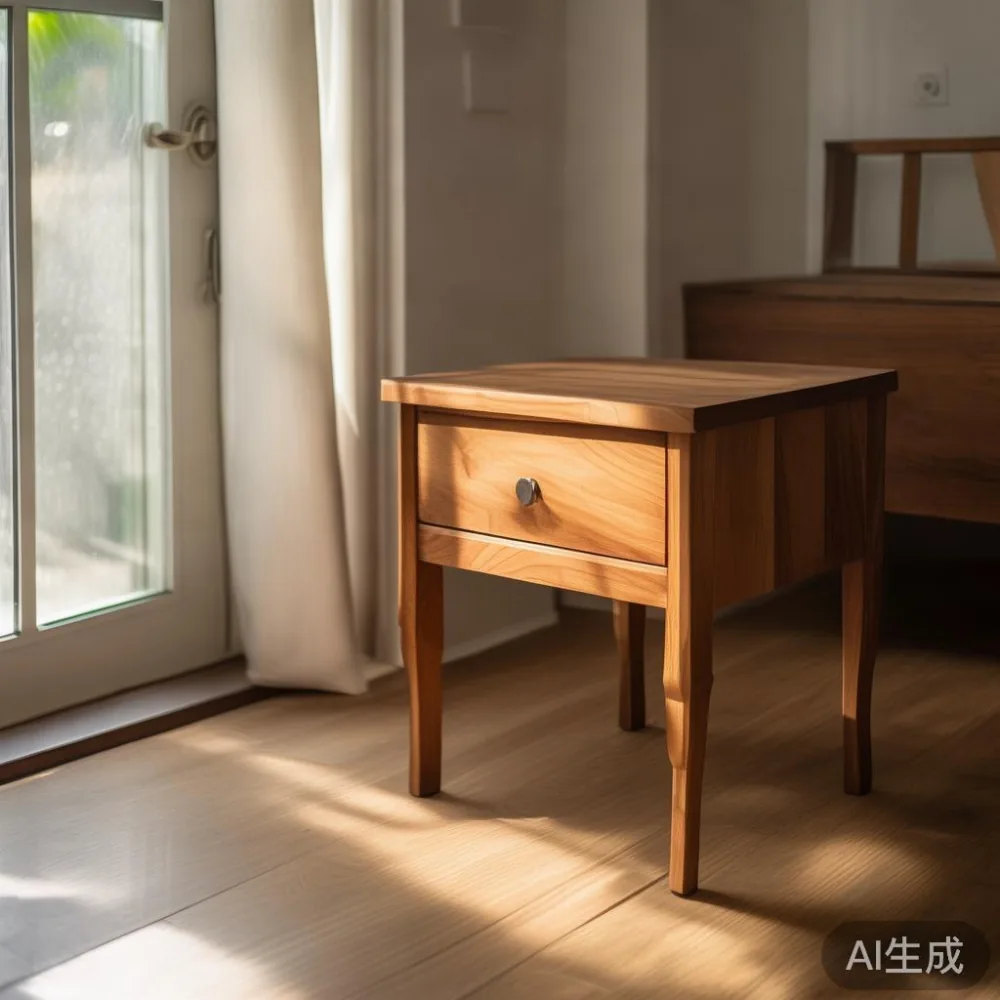
Why a 50 cm Nightstand Reacts More Than a 2.4 m Wardrobe
It feels backwards, but a small bedside unit usually shows moisture stress sooner than a large wardrobe. The reason is surface-area-to-mass ratio. A typical MIDHILL solid wood nightstand measures roughly 45 cm wide, 40 cm deep, and 55 cm tall, weighs between 12 kg and 18 kg, and exposes almost every face of its drawer panels, side panels, and back panel to indoor air. A 240 cm wardrobe by 60 cm by 210 cm is much heavier (often 90 kg and up to 140 kg), but the proportion of exposed wood per kilogram of mass is lower. That is why homeowners in Punggol and Bedok walkways sometimes see a sticky drawer on a bedside table weeks before the larger wardrobe in the same room starts to cup. The same logic explains why a 1.8 m dining table can handle a 4 mm Himalayan leap, while a 60 cm marble table develops a subtle haze on its underside within weeks if air cannot circulate beneath it.
Wood is hygroscopic. It is constantly trying to reach equilibrium moisture content (EMC) with the air around it. In Singapore, EMC for most species used in furniture (oak, ash, walnut, rubberwood) tends to land between 16% and 20%. In a Beijing or Boston winter, EMC can drop below 8%. That 8 to 12 percentage-point swing is what causes drawers to swell, panels to crown, and joinery to creak. A 40 cm-wide oak drawer front, dried to 9% in the factory, can expand by roughly 2.5 mm to 3.5 mm across its width once it acclimatises to a HDB bedroom at 82% RH. Two millimetres sounds trivial until your nightstand drawer starts rubbing and you are awake at 2:30 a.m. wondering whether the timber was defective. It almost certainly was not.
What "Light Luxury" Really Means in a Tropical Climate
Light luxury is a small enough word that people wave it past, but in furniture it has a fairly specific meaning: restrained proportions, slim profiles, calm colour palettes, and joinery that does not try to shout. French light luxury, American light luxury, and post-modern light luxury all chase the same quiet feeling, but they get there through different routes. A French piece tends to lean on tapered legs, soft curves, and neutral oak or ash tones. An American light luxury piece usually goes for thicker tops, oil finishes, and a little more grain on show. Post-modern light luxury plays with geometric contrast: square meets curve, light timber meets a honed marble top. The reason this matters for Singapore is that light luxury frames are usually built with thinner solid wood and exposed joinery, so any seasonal movement reads more honestly than it would on a heavy, painted provincial cabinet.
For a homeowner comparing a French sofa vs French provincial sofa, the same logic applies: a French sofa is usually cleaner in line and lighter in visual weight, while a French provincial sofa carries deeper skirts, scrolled arms, and more carving. In a humid room, the simpler the profile, the less moisture-trap there is. That is one reason a guide on how to style European light luxury bed in bedroom almost always starts with airflow: 8 cm to 10 cm behind the headboard, the same gap between the bed frame and a side nightstand, and clean floor beneath. Style and humidity control share the same floor plan.
Will My Nightstand Crack, Warp, or Develop Mould?
This is the question every Tampines, Bedok, and Punggol buyer eventually asks, so let me answer it as directly as possible. Solid wood furniture, properly kiln-dried and properly jointed, will not crack in Singapore. What it will do is move. Expect these seasonal behaviours from a quality piece such as a MIDHILL solid wood nightstand:
- Drawer swelling: Up to 3 mm across a 40 cm drawer face between dry-week and wet-week measurements. Plan 1 mm to 2 mm of clearance at the time of install.
- Panel crowning: Solid wood side panels may cup 0.5 mm to 1.5 mm toward the more humid face. This is cosmetic and self-correcting.
- Hairline checks: Tiny 10 mm to 80 mm checks along grain, typically at panel ends, appearing in March and September transitions. Most close back up within six weeks.
- Surface tackiness: Wipe-on oil finishes can feel gummy when RH climbs above 85%. Buff with a dry microfibre cloth, do not add more oil.
- Mould: Genuine mould on solid wood is rare in climate-controlled flats. It appears in storerooms, in unopened carton shipments, and on the underside of a marble table where air does not move.
If you see fuzzy black or green spots, that is almost always surface mildew from dust held against damp air, not the wood rotting. A 1:4 white-vinegar-and-water wipe, followed by a dry cloth, clears it within a week. The structural safety remains.
How to Style European Light Luxury for Office and Bedroom in a 90 sqm HDB
The phrase European light luxury for office sounds like a marketing line until you try to make a 12 sqm spare room work as both a guest space and a work space, which is exactly what most three-room flexi layouts in Singapore demand. The trick is to keep the nightstand slim (45 cm deep, not 55 cm) so a 120 cm desk can park beside it without crowding the doorway. Keep the bed frame at least 8 cm off the ground on a plinth or slender legs so a robot vacuum (or a Swiffer) can run underneath. Pick an Italian light luxury wardrobe with full-length mirrored doors because the mirror doubles the perceived width of a 2.7 m corridor wall and removes one piece of visual clutter. Keep the marble table on the dining side, not the bedroom side, because bedroom humidity at night peaks between 3 a.m. and 5 a.m., and stone fares worse than timber when it cannot breathe.
If you are shopping for sale Japandi furniture, this is also the moment to slow down and read the spec sheet. Japandi styling relies on pale ash or white-oak tones, very thin profiles, and visible joinery. None of that survives sloppy kiln-drying. A 4 cm thick solid ash top on a 180 cm dining table should weigh between 38 kg and 46 kg. If the listing says 22 kg, the core is hollow or the timber is rubberwood dressed as ash. MIDHILL publishes weights and kiln-drying records on its product cards, which is why a shopper comparing leaves can move on to comparing the quieter things: drawer slides, dovetail counts, finish type.
Acclimatising, Placement, and Day-One Habits That Actually Matter
Most furniture damage in Singapore happens in the first 30 days, not the first 30 years. A shipment that left a Foshan factory at 9% EMC and lands at your Bedok flat door at 18% EMC has a lot of catching up to do. Here is the practical, day-one routine I now follow for every piece, including my own nightstand and the solid wood sofa in the living room:
- Open the carton in the room, not the corridor. HDB corridors run 1.2 m to 1.5 m wide. Lift doors in most 14- to 20-storey blocks measure 80 cm to 90 cm clear opening. A 45 cm nightstand clears both, but a 60 cm marble table will not. Measure twice.
- Let the piece rest 48 to 72 hours. Wipe the inside of the carton with a dry cloth to absorb any condensed moisture, then leave the piece unwrapped in the bedroom with the air-con running at 24 to 25 degrees Celsius and 50% to 55% RH.
- Pull drawers out for the first 6 hours. Airflow inside a closed drawer cavity is the difference between 60% RH and 90% RH at the timber surface.
- Place the nightstand 8 cm to 10 cm off the wall. A nightstand pushed flat against a HDB wall traps moisture against the back panel. That is where I saw my own drawer start to swell.
- Run a dehumidifier on low. A 12 L/day Meaco or similar unit set to 55% RH keeps EMC in the 11% to 13% range, which is the band where European light luxury timber behaves itself.
- Rotate the piece 90 degrees every two weeks for the first month. This sounds fussy, but it evens out the humidity exposure during the most volatile period.
If you do all of this, you will avoid roughly 80% of the small complaints you read about online. The remaining 20% is wood movement, which is a feature, not a fault.
How Long Should a Quality Nightstand Actually Last?
When you are paying SGD 680 to SGD 1,450 for a solid wood nightstand in Singapore, the relevant question is not whether it will look good on day one. It is whether it will look good in year ten and twelve. MIDHILL's ten-year structural warranty and lifetime refinishing service exist for exactly this reason. A piece of well-dried solid oak or ash, joined with mortise-and-tenon or dovetailed corners, finished in hardwax rather than in polyurethane, should give you 20 to 30 years of service with one refinishing at the 12- to 15-year mark. A solid wood sofa frame, a bed frame, a dining table, and a wardrobe bought from the same maker at the same time will age in a similar pattern, which is why designers recommend buying a matching bedroom set rather than mixing suppliers piece by piece.
What about cost over time? A SGD 980 nightstand that lasts 25 years costs SGD 39.20 per year. A SGD 320 particleboard nightstand that delaminates in year six costs SGD 53.30 per year, plus the price of two Saturdays spent arguing with a warranty team. The lifetime cost of well-made solid wood is genuinely lower, even at the higher entry price. Add MIDHILL's free shipping over US$350 (about SGD 480), the 14-day return window, and the GST-inclusive pricing shown at checkout, and the case for a single quality purchase rather than two or three cheap ones is straightforward.
What Should I Do If My Nightstand Already Shows Humidity Stress?
Most humidity stress is reversible, and most of it does not require a service call. Work through this in order, one step per day, and reassess after a week:
- Pull the drawers out and prop them vertically against a wall for 24 hours. Airflow is the cheapest dryer you own.
- Wipe all surfaces with a barely damp microfibre cloth, then a dry one. Never soak the wood.
- Move the unit 8 cm to 10 cm off the back wall and 5 cm from the side wall.
- Run a dehumidifier at 55% RH for five to seven days.
- If a drawer still binds, plane 1 mm off the bottom edge of the drawer face only. Do not plane the drawer side, or you will create a gap you cannot close later.
- If the top has a milky haze, that is moisture trapped in the finish. Lay a dry cotton cloth over the haze and press a warm (not hot) iron over it for 10 seconds. The moisture escapes back into the cloth.
If the unit is still misbehaving after two weeks of careful drying, photograph the affected area, the order number, and the unit's serial plate, and email midhillco@gmail.com with the photos. MIDHILL's team responds within two working days and, if the issue is structural, will arrange a refinishing or replacement under warranty. That kind of after-sale is rare enough in the Singapore furniture market that it is worth naming.
How Does This Affect a Bedroom Set, Sofa, and Dining Table at the Same Time?
If you are buying more than a nightstand, the humidity logic compounds. A solid wood sofa frame in the living room needs 10 cm to 15 cm behind it because the wall behind a HDB sofa runs along the service yard wall in many layouts, which holds moisture. A dining table from this 1.6 m to 2.2 m range needs a centre leaf that can be removed in dry weeks and stored flat, because table leaves warp faster than table tops. A wardrobe needs 2 cm to 3 cm of clearance at the top if it sits in a recessed HDB nook, otherwise the top panel will crown upward and crack the cornice. None of this is exotic knowledge; it is just the lived reality of designer European light luxury furniture being asked to perform in a 90 sqm flat with 80%+ outdoor humidity and air-con cycling through six nights a week.
The pieces that tend to behave the best in Singapore are the ones designed for the climate from the start: kiln-dried to 9% to 11% EMC at the factory, joined with floating tenons that allow movement, finished in breathable hardwax oil rather than in thick polyurethane, and offered with a real warranty backed by a maker that has been exporting solid wood furniture since 2008. That combination is what separates a quiet bedroom from a creaky one, and it is what makes a small nightstand one of the most informative pieces you can buy for any HDB flat in Tampines, Bedok, or Punggol.